
What Does Justice Look Like for Eatonville?
Every new plan for the Hungerford property comes with a picture of Eatonville's future. Before anybody tells this town what can go on its land, there is a question that comes first: what does justice look like?
By Julian Johnson · Published 2026-09-17 · 14 min read
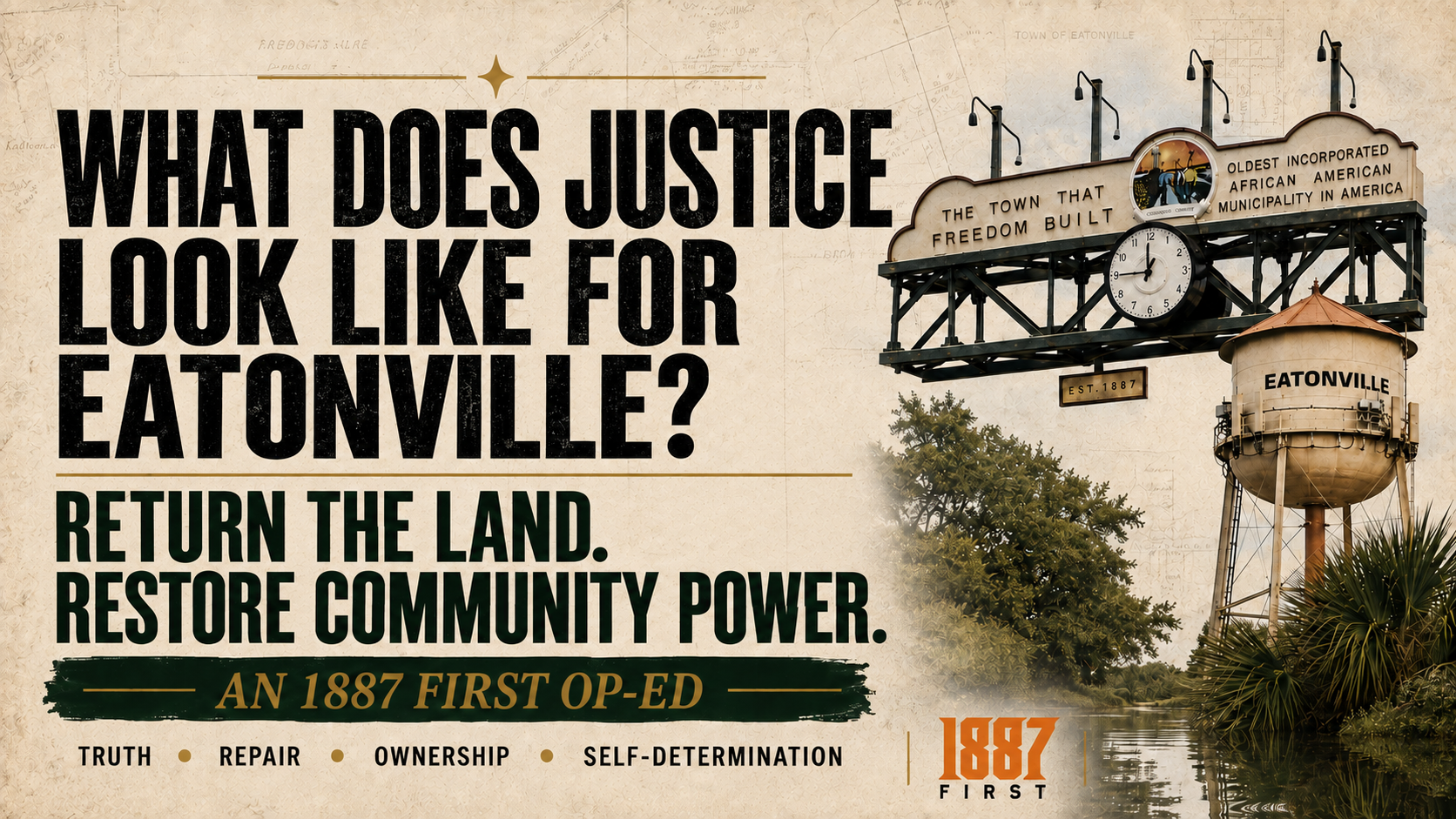
Editor's note: This is an opinion column from 1887 First founder Julian Johnson.
Every new plan for the Hungerford property comes with a picture of Eatonville's future. Before anybody tells this town what can go on its land, there is a question that comes first.
What does justice look like?
It is not keeping the name Hungerford on a sign while somebody else takes the land. It is not a museum that tells a comfortable version of our history while the people who took the land walk away clean. It is not asking residents to advise a project after every real decision has already been made.
Justice starts with telling the whole story.
We have read the deeds now. Here is what they say.
Two teachers built this school
Russell Calhoun and Mary Calhoun came here from Tuskegee and built a school for Black children at a time when the county would not.
You will not find their names in the lawsuits. You will not find them in the school district's account of this land. You will not find them in the official history.
They are in the deeds.
In 1900, Edward Hungerford signed forty acres over to Russell Calhoun as trustee, with instructions to use it for the school. In 1924, Mary Calhoun signed a deed as a trustee of the school herself. Her signature has been sitting in the Orange County public records for a hundred and two years, and almost nobody has looked at it.
That is what it looks like when a community loses hold of its own story. The people who built the thing disappear from the record of what happened to it.
Neighbors gave the land
Between 1899 and 1911, about 337 acres came together. We counted it parcel by parcel from the original deeds.
Samuel and Mattie Moseley signed over 80 acres for one dollar.
The Cleaveland family gave 40 acres for five dollars. Nancy Hungerford gave 40 for five. Edward Hungerford gave 40 for five. John Shufton sold 40 for a hundred and twenty five.
Add up every dollar anyone was paid for this land and it comes to about $3,646. And $3,500 of that was one real sale, to one family.
These were gifts dressed up as sales. People wrote "one dollar" on a deed because the law wanted a number in the blank.
They gave it so Black children could go to school.
A Black college wanted this school
By 1950 the trustees had decided the school could not keep running on its own. That part is true and it is in the court record.
What almost nobody knows is that there was another way, and it was standing right there.
Bethune-Cookman wanted Hungerford.
Mary McLeod Bethune had started her own school in Daytona Beach in 1904, five years after the Calhouns started theirs here. Same generation. Same idea. A Black school, built by Black educators, for Black children, in a state that would not build one for them. By 1950 hers had grown into a college.
Her college came to the table about Hungerford. The trustees had already given their word to the county school board.
And then something worth sitting with happened in court.
When the judge weighed whether Hungerford still needed to exist as a private school, part of what he looked at was why Bethune-Cookman and Florida Normal in St. Augustine had shut down their own high school programs.
Read that again.
Black colleges across Florida were being squeezed out of secondary education. And that squeeze got used as proof that this school was no longer necessary.
The closing of Black schools was offered as the reason to close a Black school.
That is not a theory about intent. That is what is in the opinion.
Bethune-Cookman is still here. It has produced teachers, pastors, lawyers and legislators across this state for a hundred and twenty years, including the father of the senator who now represents Eatonville. Many of us went there. I did.
So when people ask what Eatonville lost, part of the answer is an alliance that never got to happen. Two institutions built in the same decade, for the same children, by people who understood the same thing. They were meant to hold each other up.
One of them got to keep going.
The other one got sold for sixteen thousand dollars.
What the school board agreed to
In 1951 a court handed 300 acres of it to the county school board for $16,571.56. The family's own lawyer told the appeals court the land was worth more than $200,000.
The court set conditions. According to filings in the litigation over this property, the land was to be a public school for Black children, with vocational training, and it was to keep the Hungerford name. We have requested the 1951 order itself from the Clerk of Courts and will publish it when it arrives.
Court filings also state that sixteen years later, in 1967, the school board changed what the school was for and took the Hungerford name off the building. People here sued to keep the name. They lost.
We have asked Orange County Public Schools for its records of that 1967 vote.
Then it went like this.
In 1974 the district went to court and got the education requirement cancelled so it could start selling. We have requested that judgment too. The school district's own written timeline and other public accounts describe its reach differently, and we are not going to characterize it until we have read it.
Between 1978 and 2008 it sold about 112 acres for roughly $7.8 million. Five of those acres went to the state in 2008 for $6,442,900.
In 2009 it closed the school.
In 2010 a federal court finally released the district from its desegregation order, which means it held this land under that order the whole time.
In 2020 it knocked the buildings down during the pandemic, with almost no notice, after residents had used that campus for youth sports and events for eleven years. State law offers money to restore historic school buildings. The district never asked for it.
In 2022 it paid $115,000 to clear the last requirement off the title.
And now it is handing over the last 117 acres for $1 million in cash. Its own lawyer told a school board work session in January that nobody had appraised the property and they did not know what it was worth.
Five acres brought $6.4 million in 2008.
One hundred seventeen acres are going for $1 million in 2026.
The rule that never made it onto the paper
Here is the thing we found that explains how all of that was possible.
We pulled the actual 1951 deed. It is filed at the Orange County courthouse, Deed Book 867, page 247. Anybody can go look at it.
There is no education requirement in it.
The deed hands the land to the school board and its successors, forever. The only things held back are the chapel, the furniture in the chapel, and a path to walk to it.
The judge's conditions are in the court file. They never made it onto the deed.
For seventy five years everybody has talked about "the 1951 deed restriction," including us. There is no such thing. There is a court order that says one thing and a deed that says another, and the deed is what a title company reads.
So somebody should ask: who wrote that deed, and why does it leave out what the judge ordered?
Why the law backs this up
The court in 1951 used a rule called cy pres. It is old French for "as near as possible."
Here is what it means in plain terms. When land is given for a charity and the original plan stops working, a judge can move it to a new plan that comes as close as possible to what the givers wanted.
Two things about that rule matter.
First, the judge has to find that the givers had a broad charitable purpose. If they only had one narrow idea in mind, the rule does not apply, the gift fails, and the land goes back to their families. The judge in 1951 had to make that finding. He made it.
Second, and this is the part everybody skips: the rule changes the plan. It does not cancel the purpose. The land stays charity land. The new plan steps into the old plan's shoes. That is the entire point of the rule, to keep charity money in charity instead of letting it leak out.
Which means the conditions in that 1951 order were not extras tacked onto a gift. They were the deal. They are the reason the judge could hand the land over at all.
So the school board did not win a prize in 1951. It was handed this land to hold for a purpose. In plain terms, as a trustee.
That is not an opinion. That is what the rule says, applied to a court order and a deed you can go read yourself.
Nobody was in the room for the children
In 1951 the Florida Attorney General was in that case. His name was Richard Ervin, and it is printed in the deed. The court wrote that he was there to speak for the public, including the people the trust was created for.
Florida law puts the Attorney General in that seat for a reason. The people a trust like this serves cannot speak for themselves. They do not have names on a list. They are the children of one town, and most of them were not born yet when these decisions got made.
In 1974, when the education requirement was cancelled: no Attorney General.
In 2011, when the Town sued to remove the rest and the school board filed paperwork saying it did not object: nobody.
In 2015, when a settlement went through and the case was dropped eight days later: nobody.
In 2016, when the parties signed an agreement after the case was already closed, and never filed it with the court: nobody.
In 2022, when the last release was signed for $115,000: nobody.
Five times. Fifty two years. Not once did anybody stand in that room for the children this land was set aside for.
Was this on purpose?
When the same things keep happening to the same Black town, it is fair to ask whether it was an accident.
We are going to be careful here, because being careful is what makes this stick.
We cannot prove that the people who made these decisions in 1974 or 2011 or 2022 were trying to hurt Eatonville. We have not found that proof and we are not going to claim it.
But we do not need it.
What the record shows is simpler and it is written down: every single time this obligation got weaker, the people it belonged to had nobody there. Not because anybody was hiding. Because the law requires somebody to speak for them in some hearings and not others, and in these, nobody bothered.
That is a pattern you can look up. It is in the court files. And it is enough.
One more thing, and it is about us. Plenty of families here made the call they thought would protect their kids. They moved. They sent their children to school somewhere else. They built lives outside this town. Nobody should call that giving up on Eatonville. When a place loses its school, its land, and its say, people leaving is a sign of what was done to them, not a sign that they stopped loving home.
A new name does not erase the old one
Dr. Phillips Charities calls its plan the Eatonville Initiative and describes it as preservation, education, health, housing, and opportunity.
The school board approved the sale on January 13, 2026. The price is $14 million on paper. One million due at closing. Up to $13 million forgiven as four projects get built. The Town asked for ninety more days to read the contract and was told no. The Town asked for the right to buy the land back first if it is ever resold. That was not added.
The charity set up an advisory committee. Its chairman told the school board in January that the committee would hold Dr. Phillips accountable, with full transparency. The charity's own website says the committee is there "to help inform this process."
Advising is not owning. Being listened to is not agreeing. Being looked after is not running your own affairs.
Here is what we are worried about. A well funded project could turn Dr. Phillips Charities into the hero of Eatonville's story, while seventy five years of school board decisions fade into the background. This town could end up with a museum about its history and no say over how that history gets told.
That is not preserving history. That is replacing it.
Restitution is not a fantasy. Florida has already paid it. Three times.
People will tell you nothing can be done about something this old. Florida has already proven otherwise, three separate times, and twice right here in Orange County.
Rosewood, 1994. Seventy one years after a white mob destroyed a Black town in Levy County, the Legislature approved $2.1 million. Two million went directly to survivors and families. The rest started a college scholarship fund that still exists.
Ocoee, 2021. One hundred and one years after the Election Day massacre three miles from here, Governor DeSantis signed a budget creating the Randolph Bracy Ocoee Scholarship Program. Up to 50 scholarships a year, up to $6,100 each.
Read the eligibility rules for that one, because they matter to us. The scholarship goes to direct descendants of victims or to Black students living in Ocoee today. You do not have to prove your bloodline. You have to be a young person from that town.
Students apply through the Florida Attorney General's Office.
Groveland, 2026. This past June, seventy seven years after four young Black men were framed for a crime they did not commit, Governor DeSantis signed a budget with $4 million in it. One million for each family. The money came through the Attorney General's budget. A Lake County commissioner insisted the state call it restitution, and said the point was that the legal system had failed to live up to its own rules.
That is exactly what we are saying happened here.
None of those came fast. Rosewood took seventy one years. Ocoee took a hundred and one. Groveland took seventy seven. The senator who spent years fighting for the Groveland families, Geraldine Thompson, died before the money came through.
What survived her was the record. Somebody had written it all down, so when the moment finally came, the case was ready.
What we are asking for
Put the purpose back on the land. Before any deed changes hands, there should be a charitable requirement recorded on the title, enforceable for Eatonville's children, today's and tomorrow's.
This is the whole lesson of 1899. Families handed over land on a handshake and a shared purpose. The purpose was real. The people meant it. And when that generation was gone, there was nothing written down anywhere that held the next one to any of it.
A recorded document outlasts boards, mayors, and leadership changes. A mission statement does not.
Account for the money. The $115,000 from 2022. Whatever was paid under the 2016 agreement. And the roughly $7.8 million from earlier land sales. Where did it go, and did Eatonville see any of it.
Fund the children. Ocoee got a scholarship fund for its young people. Rosewood got one. Eatonville should have one too, and it should be bigger than a scholarship, because what was taken here was a whole school.
What belongs here is a permanent education fund for the children of this town. Run by this community. Written in a form nobody can sign away for a payment. Early learning through trades, technology, college, and adult training, so a child from Eatonville does not have to leave Eatonville to get every level of what they need.
That is what cy pres actually calls for when a plan fails. Not a sale. The nearest thing to the original purpose.
Test the ground. Court filings say school board members talked in a closed meeting in October 2024 about whether a dump had been put on this property. Dr. Phillips is running environmental checks right now as part of closing. Those results should be public. Nobody here should have to get sick before somebody tests the soil.
Write it down. Public reports. Outside oversight. Real deadlines. Protections against displacement that are in the contract and not in a brochure. And money that comes back if the promises do not get kept.
Justice is not charity
Charity built this school. Charity is the word a court used in 1951 to move it for less than nine cents on the dollar. Charity is the word on the paperwork right now.
Eatonville does not need another organization to explain why we should be grateful somebody found value in our land.
Our people made that value. They put the acres together, built the school, taught the children, and ran a Black town that governed itself through an era built to make that impossible.
Samuel and Mattie Moseley signed over eighty acres for one dollar and promised their children's children would defend that school's title forever.
They never asked for anything back.
We are not asking for a check for anybody living either.
We are asking that what was given be put back. In writing. Under this town's control. Still standing for the children who come after us.
And we are not going to stop asking. Rosewood waited seventy one years. Ocoee waited a hundred and one. Groveland waited seventy seven.
Eatonville can wait too. But somebody has to keep the record, so that when the moment comes, the case is sitting there ready.
That is what justice looks like.
About this reporting
About this reporting. Everything above comes from a recorded deed, a court ruling, a public meeting record, or the school district's own paperwork. That includes the 1899 trust deed at Deed Book 152 page 110, every donor deed from 1899 through 1911, the 1951 deed at Deed Book 867 pages 247 through 269, the 2022 quitclaim deed, and two Florida Supreme Court rulings, Jordan v. Landis in 1937 and Fenske v. Coddington in 1952. All of it is in our document library. Go look for yourself.
What we have not seen yet. Three documents in this story are described here from court filings and agency records rather than from the originals: the 1951 court order setting the conditions, the 1974 judgment cancelling them, and the 1967 school board vote that removed the Hungerford name. We have requested all three. We have marked them in the text, and we will publish them when they arrive, including anything in them that changes what we have written.
We have asked. Written questions went to Orange County Public Schools, Dr. Phillips Charities, the Town of Eatonville, Orange County and the Florida Department of Transportation. We will publish their answers. If they do not answer by our deadline, we will say that too, and we will say when we asked.
Disclosure. I founded 1887 First and I have publicly pushed for community control of the Hungerford property.
Corrections. While reporting this we dropped two things we had been ready to print. One was that a family's deed let the land come back to them. One was that the buyer paid the school board during the private negotiations. We pulled the documents. Neither was true. We are telling you because a record that never corrects itself is not worth much.
Sources and documents
- 1899 trust deed, Deed Book 152, page 110, Orange County public records
- Donor deeds, 1899–1911, Orange County public records
- 1951 deed, Deed Book 867, pages 247–269, Orange County public records
- 2022 quitclaim deed, Orange County public records
- Jordan v. Landis (1937), Florida Supreme Court
- Fenske v. Coddington (1952), Florida Supreme Court
Corrections and updates
No corrections have been issued for this story.
Support the work
Fund the Eatonville Truth & Impact Study
Your gift supports independent research, records requests, and publication. Zeffy passes 100% of your donation to the work.