Hungerford: The School Board Must Account for the Land, the Money and the Educational Promise
The Orange County School Board should provide a full public accounting of Hungerford’s land, the money connected to it and the educational purpose behind its transfer.
By Julian Johnson · Published 2026-10-04 · 4 min read
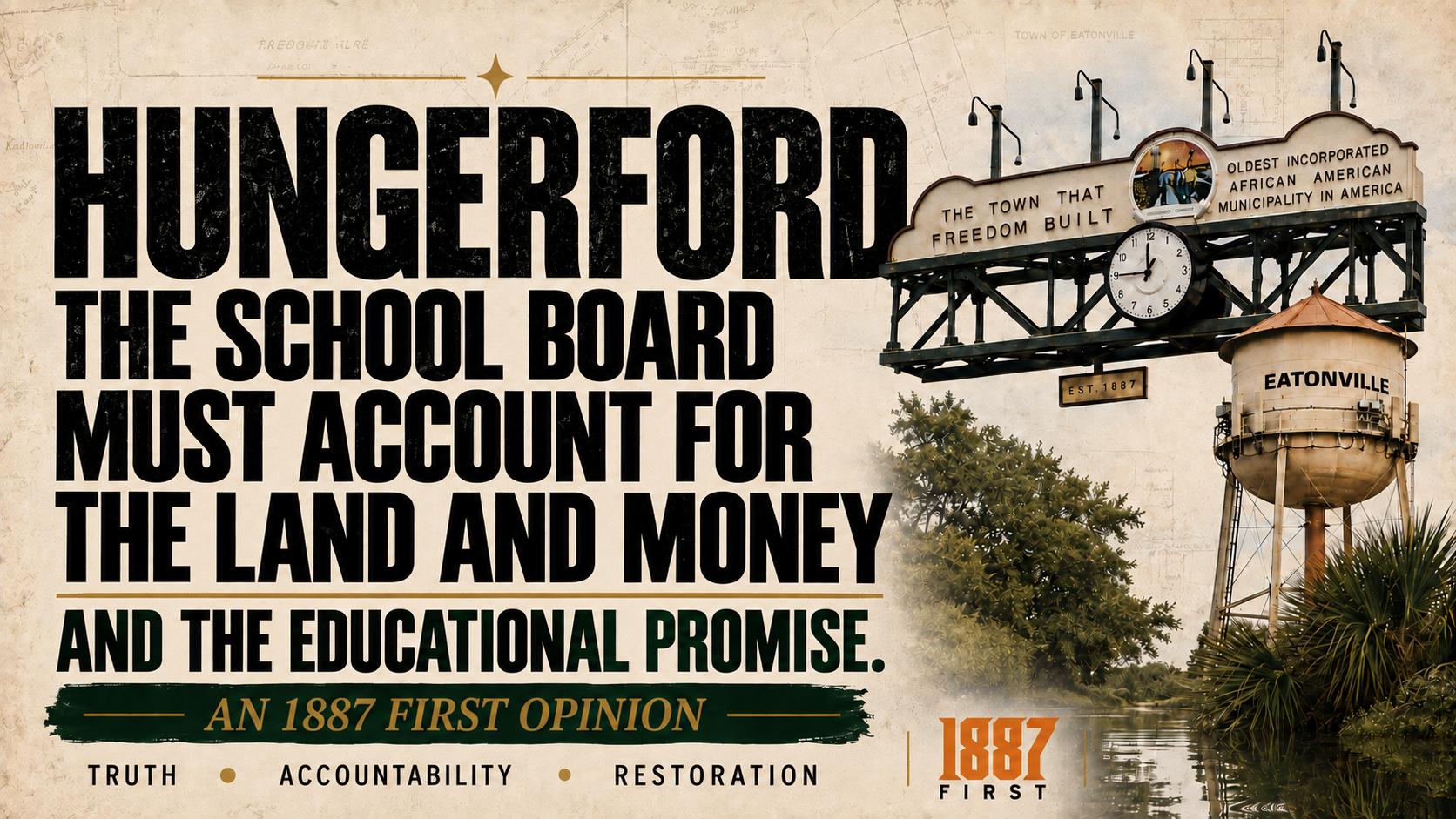
By Julian Johnson, Founder of 1887 First and Executive Director of The Ville CDC
The Orange County School Board should provide a full public accounting of what happened to Hungerford’s land, the money connected to it and the educational purpose that justified placing it under public school control.
That accounting should be understandable to the families whose lives and opportunities are part of this history. It should explain each transfer, each change in restrictions and what the community received in return.
Before we accept another vision for Hungerford, we need answers about the responsibility that came with it.
The court record is clear about why education belongs at the center of this conversation. In its 1952 decision in Fenske v. Coddington, the Florida Supreme Court upheld the transfer to the county’s public school authority under the doctrine of cy pres. The decision reproduced the lower court’s requirement that the property be used for a public school for Black students, with an emphasis on vocational education and the Hungerford name. The court’s reasoning was that the transfer would carry forward the charitable purpose as closely as possible.
That history raises a question the School Board should answer publicly: How did its later decisions continue that educational purpose?
Answering requires more than identifying who held title. It requires explaining the court orders, agreements and decisions that followed, and showing what educational benefits resulted.
Our position is that this responsibility deserves a complete examination.
For families, the stakes are practical. A parent looking for tutoring, a suitable school or help paying for a child’s training knows that educational opportunity costs money. Transportation costs money. Equipment costs money. Taking time away from work to reach a program outside the community costs money.
When we discuss restoration, we should be asking what resources would make those opportunities available here.
We should also listen to the people who experienced Hungerford. Alumni, former employees and families hold knowledge about what the school provided, how it changed and what those changes meant. Their experiences belong alongside the deeds, court records and financial documents.
Residents should not be blamed for failing to uncover a history scattered across decades of institutional records. Public bodies have a responsibility to explain their decisions. Families deserve the opportunity to examine that explanation and question it.
We are asking the School Board to publish a documented history of its stewardship of Hungerford, including the properties transferred, the consideration received, the restrictions changed and the authority for those changes.
We also want an accounting of how proceeds were used. A sale price alone does not tell the community where the money went or whether it supported Hungerford’s educational purpose.
Scholarship commitments require their own accounting. For any agreement promising money for Hungerford scholarships, the relevant institutions should identify what was promised, what was paid, who administered the funds and what students received. Where records are missing or commitments remain unresolved, that should be stated plainly.
These are questions that can be answered with records.
The Eatonville Truth and Justice Initiative is our effort to bring those records together and connect them to what families need today. The Ville CDC is leading the community research, and 1887 First is helping publish the findings and share stories with participants’ permission.
Our first fundraising goal is $10,000. That phase will support records collection, interviews, research and an initial public report. We intend to produce a documented chronology, an evidence index, a summary of educational needs and a packet for independent attorney review.
People contributing to this work should be able to see what their support makes possible. We will need to report what we have obtained, what remains unanswered and what the evidence supports.
That is the foundation for a serious campaign for restoration and possible restitution.
The legal questions require qualified review. We should not promise families compensation or tell them they will receive land. We should establish the facts, identify the obligations that applied and determine what remedies may be available.
At the same time, the community can begin defining what meaningful restoration should accomplish.
I believe it should include lasting support for education: scholarships for college and trade school, paid apprenticeships, tutoring, adult learning and resources to build community educational institutions. Hungerford’s purpose of educating Black children should remain central to that discussion.
A permanent education fund is one possibility worth developing. It would need dependable funding, clear rules, community participation in its governance and public reporting on who it serves. Families should have a meaningful role in deciding which opportunities receive support.
Restoration should also address the barriers that keep people from using those opportunities. A scholarship may be insufficient if a student cannot afford transportation, tools or the time required to attend. Listening to families will help us build proposals around those realities.
There is work people can do now.
If you attended Hungerford or Wymore, worked there or have photographs, letters, yearbooks or scholarship records, we want to hear from you. Keep your originals. We will discuss permission and copying before collecting materials.
If you are a parent, caregiver or adult learner, tell us what opportunities you need and what makes them difficult to access.
If you can help research, organize records, conduct interviews or connect us with educational and legal expertise, there is a place for you in this work. You do not need to know the entire history before contributing.
And if you can give, joining our Donor Circle will help fund the time and research needed to produce a record the community can use.
Complete our community form to share your experience, identify educational needs or volunteer.
The School Board must explain what it did with the responsibility it received. Our work is to assemble the evidence, make it accessible and pursue a response that reaches families through real educational opportunity.
Hungerford’s future should be judged by what it makes possible for the people its purpose was meant to serve.
Corrections and updates
No corrections have been issued for this story.
Support the work
Support the Eatonville Truth and Justice Initiative
Your gift supports documentation, community programs, and publication. Zeffy passes 100% of your donation to the work.